Challenge Day 16

When I sat down to write this blog, I considered approaching it by discussing the differences between my husband and I when it comes to being a student. I was always a good student—I enjoyed school, got good grades for the most part (my math and science teachers may disagree on that one), and just kept going and going and going through to the PhD level. Honestly, much of my education was easy for me until the graduate level, when I had to put in some honest, hard work. I was—and still am, in many ways—a good learner.

But my husband? He claims to never have been a good student. Maybe not bad, but perhaps the word he would choose (if he used words like this) would be mediocre. Now, as a new student of the Bible—new, meaning that the past few years have been the only time in his life that he has actually tried to read it and learn from it—he struggles. He struggles because he is unfamiliar with the material and finds some concepts difficult to grasp; he also struggles because he has a notoriously bad memory. (I’ll admit to adding the word notoriously in there.)

That’s how I was going to start the blog—and how, I suppose, I did start it. After starting this way, I was going to neatly segue into today’s topic, how we can learn from the Bible. I even prepared a challenge photo to go with it:

Green owl mug sitting on a bookshelf. Photo text: Challenge Day 16, Bible-taught. #writinglifeaugustchallenge

And then I realized I was reading today’s verse all wrong.

Today’s Inspiration. The inspiration for today’s challenge is, as it has been for a few days, 2 Timothy 3:16:

All Scripture is God-breathed and is useful for teaching, rebuking, correcting and training in righteousness. (NIV)

The focus today is All Scripture is … useful for teaching.

Do you see my mistake?

All Scripture is useful for teaching. Teaching, not learning, as I was thinking of it. Of course, if the Bible (and I’m including the New Testament in here, which Paul didn’t have—but was writing a large part of—when he used the word Scripture) is useful for teaching, then it is also useful for learning from. But when Paul wrote this, he was writing to Timothy who was in a place of authority in the ministry. He was leading the ministry, at the same time that Paul was teaching him how to minister.

There is a big difference between being the teacher and the student. I can say this from years of experience, because I’ve been both. In fact, when I started teaching I was simultaneously learning how to teach and learning material I wasn’t teaching at all. That’s the paradox of a graduate teaching assistant—in charge of my own classes, learning what tools to use to teach as I was teaching, but also taking my own classes in subjects far beyond my students’ level of learning. That’s a bit how I imagine Timothy here: He’s done taking his own classes and set loose on his own, a bit like the dissertation-writing time for a PhD student. He’s already leading and teaching, but he also still needs advice from his advisor, Paul. So they write back and forth, and what we have here is Paul giving Timothy some advice.

And what is he saying? He’s saying All Scripture is … useful for teaching. You have the textbook to teach from, Timothy. When you build your curricula, use that. Any of it. All of it. Because all Scripture is useful for teaching.

Same photo as above: Green owl mug sitting on a bookshelf. But the text has been changed. It still says Challenge Day 16: Bible-, but the word taught is crossed out in red and the word “teaching” is suggested as a replacement. It still has #writinglifeaugustchallenge.

But where does that bring us? I suppose that depends on where you already are.

Today’s Challenge. The thing about teaching is that, ideally, the teacher should know the subject well before attempting to teach it. When Paul told Timothy that all Scripture was useful for teaching, he knew that Timothy knew his Scripture. He had been brought up in the faith and had taken it as his own (2 Timothy 1:5).

There was something going in in Timothy’s ministry, too—he was dealing with a bunch of people who were teaching things that were “off” from what the Scripture or what Jesus had taught (which lined up with, you guessed it, Scripture). So Paul was telling him that Scripture was the tool he could always rely on for teaching—all of it.

This brings us to the “where you are” question, and to today’s challenge. First, prayerfully examine where you are in your walk with the Lord. Are you new to your faith, still learning? Have you believed in Jesus as your Savior for a long time, but still don’t know your Bible well? Do you know the Bible in and out, love what it says, and try to live it out? Somewhere in between? Does it depend on the day?

Next, try reading 2 Timothy 3:10-17 (or even more of the chapter/book). Get a wider sense of what Paul was telling Timothy. And then consider: Are you to the point of, or in a position in which you are teaching others of your faith? About God’s redeeming love, Jesus’ death and resurrection, about godly living—any of it? Or would you need to learn more yourself before attempting to teach? In both situations, the answer is God’s word: consider God’s word, all of it, the primary teaching material. And when you sit under someone else’s teaching (because all of us are still learners), find someone who teaches God’s word to do it.

Today’s Participation. Are you a teacher? A learner? Both? Either face to face or online, share with someone what you learned about yourself and the Bible in today’s challenge.
Challenge Day 15

Review. It’s already (only?) the midpoint of the Writing Life Challenge! Just creating each day’s challenge is a challenge for me—I’m barely keeping up! How about you?

In case you missed the original idea behind the challenge (which, admittedly, has evolved a bit) or any of the challenge posts, I’ll post an easy-access review here:

Day 1: Thankfulness & Prayer
Day 2: Praise & Prayer
Day 3: Watchfulness & Prayer (now my #2 fave—it’s been replaced!)
Day 4: Devotion & Prayer
Day 5: How to Pray
Day 6: Who to Pray For
Day 7: What to Pray For
Day 8: When to Pray
Day 9: Where to Pray (knocked into my #3 fave place)
Day 10: Why to Pray
Day 11: Fasting & Prayer (my new #1!)
Day 12: Why Read the Bible? (My own answer to this is also near and dear to my heart)
Day 13: God-Breathed Scripture
Day 14: The Bible is Useful

Have you noticed a theme yet? I’m focusing on getting us back to (for some of us, started on) the basics: Daily prayer and Bible-reading. So what’s next?

Today’s Inspiration. What’s next is the last item in the short list of what Paul tells us the Bible is useful for:

All Scripture is God-breathed and is useful for teaching, rebuking, correcting and training in righteousness. (2 Timothy 3:16, NIV)

Training in righteousness. That’s what we’ll focus on today. But I think before we move forward, a bit of context is important here.

When Paul wrote the books of 1 Timothy and 2 Timothy, he was writing to Timothy. Timothy was younger than Paul and trained by Paul to be a leader in the ministry, and these letters were Paul’s ways of continuing to instruct him. In the area Timothy was ministering in, people were beginning to come up with all sorts of stories and teachings that just didn’t line up with Scripture and with Jesus’ teaching, and Paul was giving Timothy advice on how to deal with that. That’s where we come to this verse, to Paul claiming that all Scripture … is useful for … training in righteousness. For training the people of God—people to whom one may be ministering—as well as for training oneself.

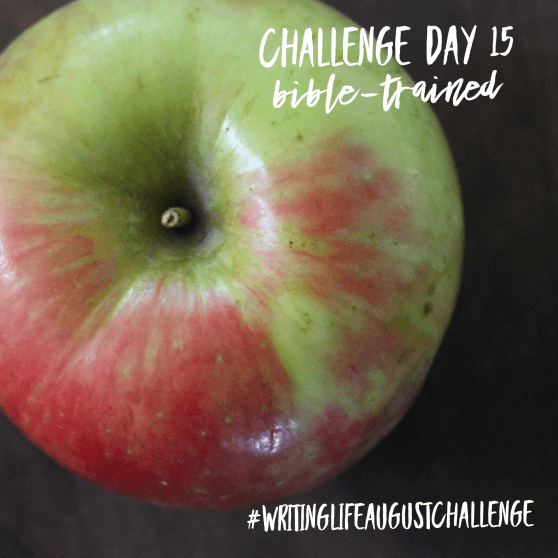
Top-down view of an apple on a wooden table. Photo text: Challenge Day 15, Bible-trained. #writinglifeaugustchallenge

Today’s Challenge. Training in righteousness. What does that mean? And what is righteousness? Your challenge today is to explore the answers to these questions and think about how this applies to your own life. You could focus on the word training, on the word righteousness, or on both words.

Need help knowing where to start? The concept of training also appears in Hebrews 12 (especially verses 1-13). You could start on righteousness by pulling out a dictionary, but then you would need to look and see how the word is used and described in the Bible to get the full meaning. The word is used throughout the Bible, starting with Genesis. Looking at what the Bible says about Abraham and his righteousness—in both the Old and New Testaments—is a good place to look to begin to grasp the concept. Then you could put the two together—examine what training in righteousness would look like in your own life.

Today’s Participation. Depict training in righteousness through a drawing, a painting, or a photo and then share it with someone, either in person or online. If you’re using Instagram, friend me @rhondalorraineblog and tag it with #writinglifeaugustchallenge. I’d love to see how different people depict this!

Challenge Day 14

Today’s Inspiration. For several years in my late twenties and early thirties, I was between churches. This Baptist-raised, Sunday school, Sunday morning, Sunday night, and Wednesday night prayer meeting—and later, youth group and college group—attending girl just stopped going for a while.

The years that I stopped going to church happened to be in my I-don’t-trust-God-with-the-big-decisions-in-my-life phase (described a bit here). That, in all honesty, was the biggest reason I didn’t go. But it also had a lot to do with a) the fact that I was dating a raised-to-go-to-weekly-mass, but didn’t-really-go-anymore-because-he-worked-seven-days-a-week Irish, Roman Catholic man (whom I married after many, many years of waiting for him to finally propose) and b) my own disappointment in the lies, the corruption, and the failure to deal with said corruption in the church I had last regularly attended—which happened to be Pentecostal.

When my boyfriend/fiancé/husband and I did occasionally look for a church, it was hard to find a balance: conservative and calm enough in its worship for him, and grounded in Biblical teaching for me. This last was extremely important to me: I needed meat, not milk (Hebrews 5:11-14), sermons primarily based in and derived from God’s word, verse-by-verse, chapter-by-chapter, or book-by-book (as opposed to the more topical sermons that use a verse or two here and there). In effect, I wanted the teaching we sat under each week to be useful in both (all, now) of our lives.

The idea of the usefulness of God’s word is today’s inspiration:

All Scripture is God-breathed and is useful for teaching, rebuking, correcting and training in righteousness. (NIV)

Today’s Challenge. Your challenge today is to examine the usefulness of Scripture—of the Bible—to your own life. Do you believe it is useful (this touches on yesterday’s challenge question, too)? Do you really use it? Do you even know enough of the Bible for it to be useful in your own life? How should, or do, you use it? All of these are questions you could consider when contemplating the Bible’s usefulness.

Stacked dishes: Gravy boat, sugar bowl, teacup without a handle, sitting in front of a plate that stands in the background. Photo text: Challenge Day 14, the Bible is useful. #writinglifeaugustchallenge

Pray for understanding and insight, both of God’s word and of your own heart, before you begin. Then, spend some time searching for answers in the Bible and in your own heart, mind, and actions. You may want to journal as you think through these questions.

Today’s Participation. Make it personal! What do you believe—really believe—about the Bible’s usefulness? Or how is it useful to you in your everyday life? Share your thoughts with someone in person, comment below, or create an Instagram post using #writinglifeaugustchallenge.


I know some of you may be wondering: Did we ever find a church? The answer is yes, resoundingly yes. The first year of our marriage, my husband and I lived apart; I was finishing courses for grad school out of state, and he stayed home at the job he had worked at for years. My brother invited us to his non-denominational church for Christmas services and we were hooked. When I moved back home nearly six months later, we started attending regularly and feasted on a regular diet of meat. Fast-forward 11 years to today: We have both grown tremendously in our personal walks with the Lord, and we have grown to love the church—the people we learn, grow, and serve with. Church is no longer merely a place to go to listen and sing and learn; it is family, it is home, it is who we are and how we live in Christ.

I also want to say a word to those who may have been hurt by something you saw or something done to you in a church before, since I mentioned having seen lies and corruption in a previous church: People are fallible. People, being people, will make mistakes and—yes—even sin. Putting our trust and hopes in people, as much as we love them, will ultimately lead to disappointment of some sort. What matters is that when sin is present, it is acknowledged, repented of, and if necessary disciplined in a Biblical manner. The church I attended in the past didn’t do that, at least not while I was there. I had made the mistake of trusting the people more than I was ready to trust God. I had it backwards. But don’t give up on all church bodies—on the church—if you encounter one that tries to hide its wrongs and ignores God’s word. Instead, find one that makes use of the word. And don’t give up trusting in God.